Good to know
What should happen first when water is coming inside?
When water is coming through a ceiling, the first priority is safety and containment rather than finding every failed detail. Turn off power to fixtures in the affected room if water is near them, and keep people and pets away from wet ceiling material that could sag or fall. Move furniture, electronics and rugs out of the path of the drip, and place buckets or containers under the lowest point of the stain.
Next, document the damage before anything is moved or cleaned. Take dated photos of the stain, any ceiling sag, the wall below it and the water on the floor, plus a wide shot of the room so the location is clear. If it is safe to do so, photograph the outside of the roof from the ground as well, noting missing shingles, debris or displaced flashing. These records help local providers understand the situation and support any conversation you have with ythe insurer.
Local conditions make this step urgent. San Marcos sits on the Balcones Escarpment in Texas Flash Flood Alley, where Hill Country storms meet Gulf moisture. Flash flooding is the most common reported hazard around the city in NOAA records since 1996, mostly in June and May, and May is the month with the highest precipitation at about 3.8 inches. A leak that starts during one heavy rain can grow quickly during the next one.
How is an emergency opening dried in temporarily?
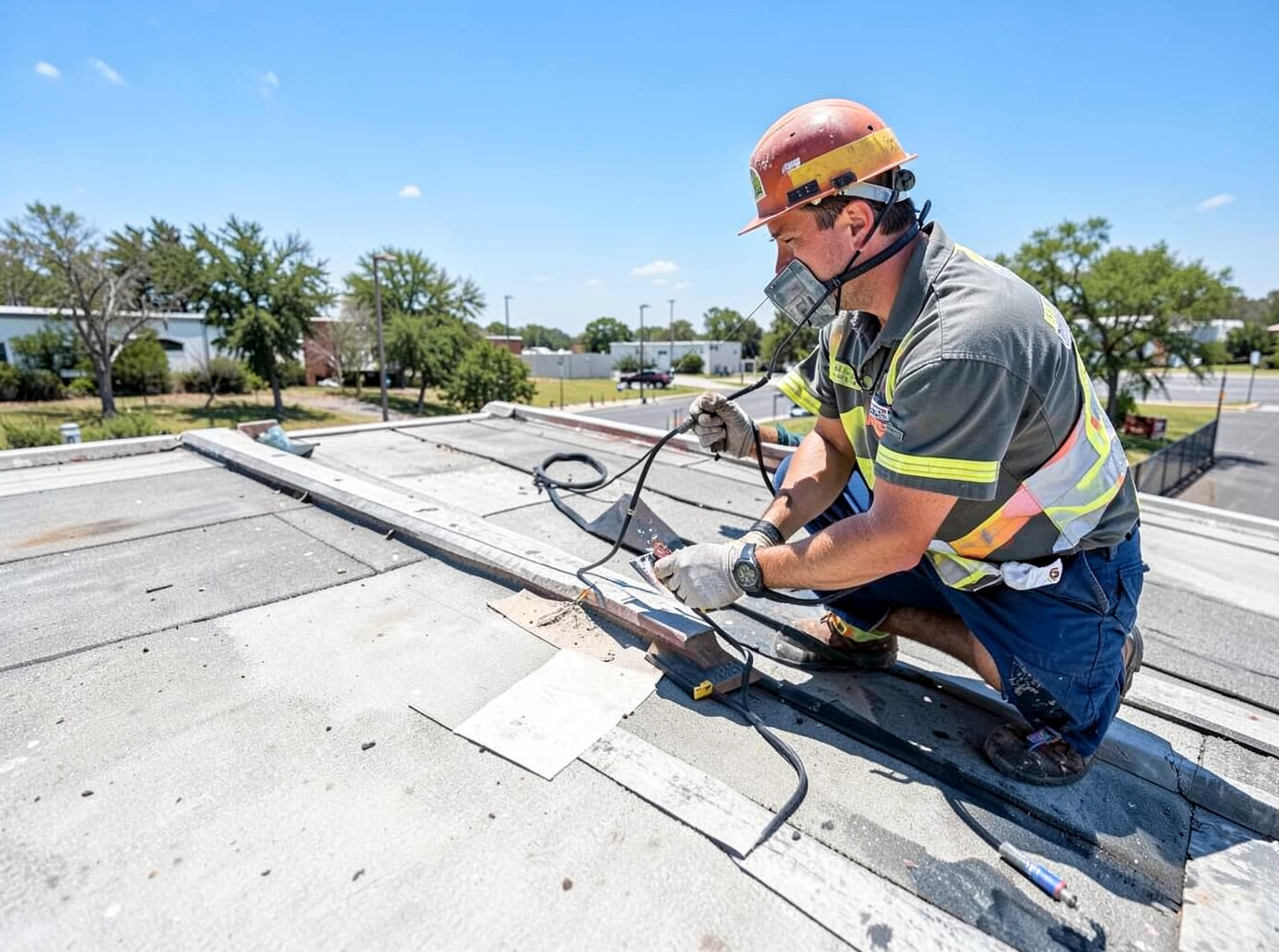
A temporary dry-in is a short-term covering that keeps rain out of an opening until a permanent repair can be made. Providers typically secure a tarp or similar waterproof sheeting over the damaged area, fastening it so wind does not lift it, and extending it past the opening so water sheds away from the roof deck. The goal is to stop new water from reaching the decking and the attic, not to match the finished appearance of the roof.
Good temporary work also manages the water that is already present. Standing water on the roof should be directed off rather than allowed to pool at the edge of the cover, and debris in valleys or around pipe boots should be cleared where it is safe to reach. Inside, a barrier can be placed over the floor, and the affected area should be ventilated so trapped moisture does not spread to adjacent materials.
Edges and seams deserve close attention. A cover that is pulled tight over a rough or cracked surface can tear at its corners, so local providers usually pad sharp edges and check that the sheeting lies flat against the roof. After a hail event, the surface may already have punctures or lifted material that are not visible from the ground. Hail as large as 3.00 inches was reported in or near San Marcos on 9 May 2024, so the damaged field may need a closer inspection once the storm has passed.
What damage spreads if an active leak waits?
An active leak rarely stays in one place. Water that enters through a flashing gap or a failed pipe boot can travel along the roof deck, soak into insulation and run down framing before it appears as a stain. Drywall can soften and sag, paint can bubble, and trapped moisture in the attic creates conditions for mold growth and wood decay over time.
The longer water stays, the more the damage tends to grow. Wet insulation loses much of its effectiveness, outlets and light fixtures near the wet area become a safety concern, and flooring can cup or stain. A ceiling mark that looks small from below can mean the attic side of the decking and rafters is already saturated, which is why providers usually inspect the attic as part of the first visit.
In San Marcos, the damage can compound after repeated storms. Because flash flooding is reported most often in May and June, a roof that is not protected after one storm may take on more water during the next. Limiting entry early is often the most effective way to keep an interior problem from becoming a larger repair.
How does the permanent repair follow the temporary fix?
The temporary dry-in is a holding measure, and the permanent repair starts only after the leak source is confirmed. Daylight inspection lets a provider check the roof surface, flashing, valleys and penetrations without the wet and dark conditions of the storm. The water path is traced from the stain back toward the entry point, which is often a detail such as step flashing, a pipe boot or a valley rather than the open shingle field.
Once the source is identified, the provider can plan the permanent work. This may involve replacing damaged shingles, resealing or replacing flashing, repairing decking that has softened, or replacing a pipe boot. Materials are matched as closely as practical to the existing roof, and the temporary cover is removed only after the permanent work is in place.
Permit questions can arise during permanent work. The City of San Marcos codes page confirms Ordinance 2023-09 and the adopted code editions, and a secondary source describes a weight test: roof covering replacement permits are not required unless the replacement roof is heavier than the existing covering. Because another secondary source states a different rule, confirm the current requirement with the City of San Marcos Planning & Development Services before work begins. If the home sits in one of the seven local historic districts, a Certificate of Appropriateness may be required for a change in design, material or outer appearance beyond ordinary repair and maintenance.
What is included in an emergency roof repair?
An emergency roof repair visit usually covers the immediate steps needed to limit active water entry and prepare for the permanent work. Typical elements include an initial assessment of the leak area, placement of a temporary dry-in over the opening, interior protection and a moisture check, and dated photo documentation. Local providers should explain what they found and what remains open for the permanent repair.
A written or photographed summary is also part of a useful visit. It can include the suspected entry point if it has been identified, the materials used for the temporary cover, the areas that need daylight follow-up, and a recommendation for the permanent repair. The scope depends on how accessible the roof is, how much decking is affected, and whether the cause is a single detail or a wider issue across the roof surface.
Which sub-services are part of emergency roof repair?
Emergency work often overlaps with several related repair types. Common sub-services include temporary tarping and dry-in, interior water protection such as moving contents and placing barriers, attic inspection, flashing repair around chimneys, vents and walls, pipe boot replacement, valley cleaning and resealing, and targeted shingle replacement where a storm has lifted or removed material.
Each sub-service addresses a specific failure point. A cracked pipe boot is repaired differently from a lifted shingle course, and a clogged valley can send water under the roofing field even when the surface looks intact. Local providers can recommend which sub-services fit the findings and which can wait for a scheduled visit once the water has stopped.
Some storm-related work also touches gutters and soft metals, which can be checked at the same visit when access allows. Hill Country hail and wind can dislodge gutter sections and bend flashing, and those conditions can open a path for water even when the shingles themselves appear intact.
Still have questions? We're happy to talk it through.