Good to know
How do you know a San Marcos roof is at replacement stage?
A roof is usually at replacement stage when the problem is systemic rather than isolated. A single cracked shingle or a failed pipe boot is normally a repair. When granules wash into gutters across many slopes, shingles curl or crack widely, decking feels soft underfoot, or leaks return in several rooms after separate repairs, the covering as a whole is nearing the end of its service life.
San Marcos adds local pressure. NOAA-based hail records show hail one inch or larger in or near the city on 15 days from 2016 to 2025, with hail two inches or larger on 3 of those days. The most recent one-inch hail day in that record was 22 May 2025 at 2.00 inches, and 9 May 2024 brought hail up to 3.00 inches. Repeated impacts like these can leave bruising and granule loss that a spot repair cannot reverse, so a provider should document whether the damage is spread across the roof or limited to one area.
Local providers will usually check attic decking, flashing, valleys and penetrations before recommending a full replacement. A roof can show its age on one slope while other sections are still sound, and that difference decides whether the answer is replacement or a targeted fix.
Ask for dated photos of every slope, close-ups of suspect shingles and a note on the attic side. Those records are useful whether you replace now, repair first or compare more than one provider's findings.
How does the city's roof-weight permit test work?
The City of San Marcos codes page confirms that Ordinance 2023-09 adopted the building codes and local amendments. The codes in effect from 1 April 2023 include the International Building Code 2021, the International Residential One/Two Family Code 2021, the International Fire Code 2021 and the National Electric Code 2020. A secondary source written scopes an exemption in the adopted amendment: roof covering replacement permits are not required unless the weight of the replacement roof is heavier than the existing roof covering.
Under that wording, replacing asphalt shingles with similar shingles is generally exempt, while a heavier covering such as concrete or clay tile or slate is permitted work. Metal and other lighter systems need a weight comparison against the existing covering rather than an assumption, because metal can weigh more or less than shingles depending on the profile and gauge. Another secondary source states the opposite blanket rule, so the weight test should be treated as the cited amendment until the ordinance text is checked.
Confirm the rule with City of San Marcos Planning & Development Services before ordering materials. Ask whether a permit requirement determination applies to ythe specific project, and request the answer in writing.
Permit applications run through the city's Building Permit process, which is guided by the adopted Building Code. This guide does not state a permit fee, and it does not claim any roofing-contractor registration requirement. Ask the city and ythe provider to confirm each item before work begins.
What changes in a historic district before material is ordered?
San Marcos names seven local historic districts: Hopkins Street, Burleson Street, Lindsey-Rogers, Dunbar, Downtown, San Antonio Street and Belvin Street. In these districts, a Certificate of Appropriateness is required for a change in design, material or outer appearance other than ordinary repair and maintenance. A change of roofing material can therefore require record even when the rest of the job is routine.
The practical sequence is to confirm whether ythe address sits inside one of those districts, choose a covering that fits the building's appearance, and submit for record before any material is purchased. Whether a particular replacement counts as ordinary repair is a judgment for the city, not the homeowner or the provider alone.
Downtown and the Belvin Street Historic District hold late-19th- and early-20th-century houses. Older roof details such as steep pitches, dormers, chimney flashing and valleys matter for both appearance and leak prevention, so the record conversation should cover the details as well as the surface material.
Which materials suit San Marcos hail and heat?
Material choice in San Marcos balances hail impact, summer heat and spring rain. August has an average high of 95°F, January has an average low of 41°F, and May is the wettest month at about 3.8 inches of precipitation, with annual averages near 35 inches. Hot afternoons and heavy spring rain both stress roof coverings, flashing and sealants.
Asphalt and architectural shingles are the most common option for sloped roofs, and they are widely available in profiles that suit many existing homes. Standing-seam and exposed-fastener metal roofing are also used on sloped homes and shed water quickly, though impact performance depends on gauge and profile. Concrete or clay tile and slate are heavier, which is why the weight test and structural questions come first. TPO and other low-slope systems suit flat or nearly flat sections.
Impact-resistance ratings vary by product, so ask local providers to show the rating for the exact product being installed rather than relying on a general category name.
Whatever the covering, underlayment, flashing, valleys, pipe boots and decking decide how long the roof keeps water out. The material conversation should include those components, not only the visible surface.
Scope included in a full roof replacement
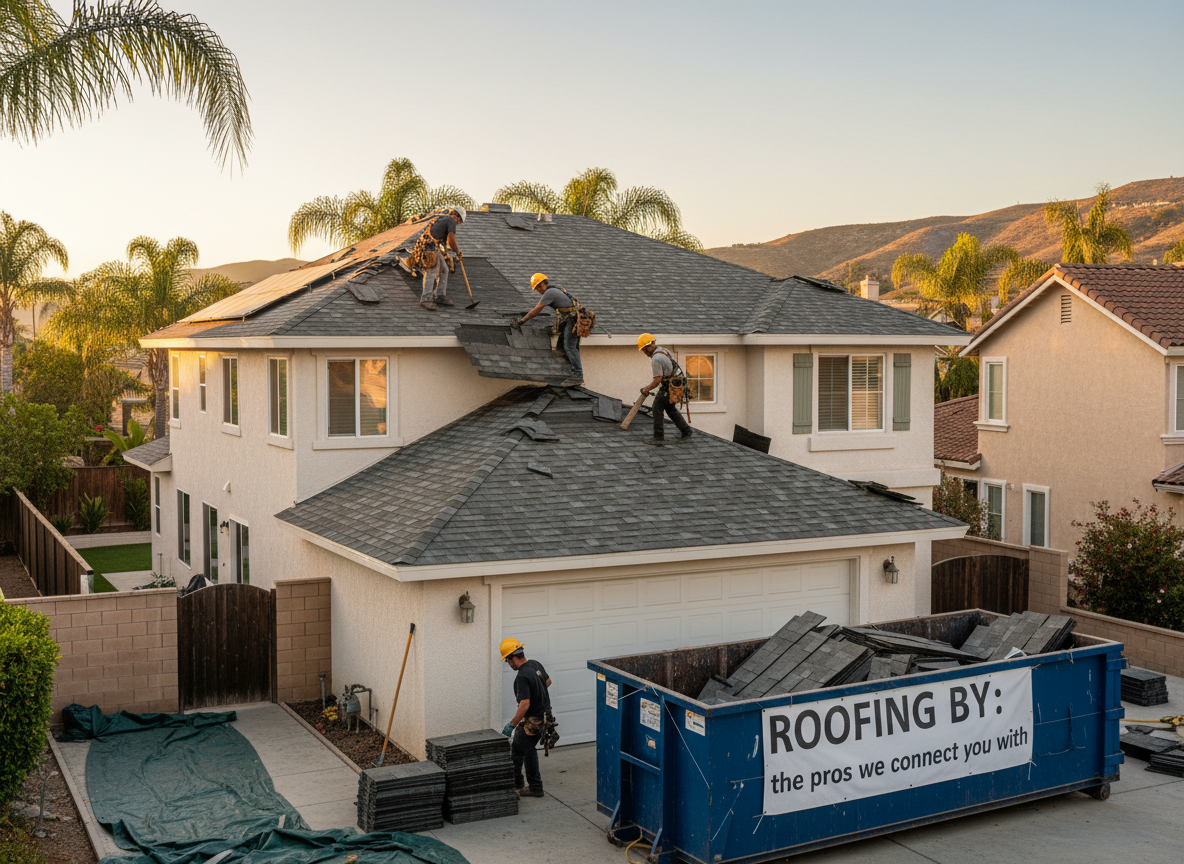
A full roof replacement typically includes removing the existing covering down to the deck, inspecting and repairing or replacing damaged decking, installing new underlayment, and fitting drip edge, step flashing, valley metal and pipe boots. Gutters, vents and ridge components are often addressed in the same job when they are worn or damaged.
Ask each provider for a written scope that lists the covering product, underlayment type, flashing details, ventilation changes, and the cleanup and debris removal method. A clear scope makes it easier to compare providers on the work itself rather than on general descriptions.
The scope should also name who handles the permit or historic-district record and which parts of the project depend on the city's weight test.
Common sub-services alongside a replacement
Several sub-services often sit alongside a replacement. Attic inspection and ventilation record can reveal condensation, insulation problems or old leak evidence that the covering alone would not show. Gutter and downspout repair keeps runoff away from fascia and foundations during heavy rain. Chimney flashing, skylight flashing and penetration resealing are frequent additions where older details have failed.
Storm-related sub-services, such as checking soft metals and documenting hail damage with dated photos, are worth considering after a hail event. April is the peak month for days with one-inch hail in the local record since 1996, so spring inspections are a practical habit. Flat-section work with TPO or another low-slope system is a separate sub-service and should be scoped on its own line.
Flash flooding is the most common reported hazard around San Marcos in NOAA records since 1996, mostly in May and June. San Marcos sits on the Balcones Escarpment in Flash Flood Alley, so check whether downspouts discharge water clear of the foundation before heavy rain season.
Still have questions? We're happy to talk it through.