Good to know
What roof issues show up in La Cima's newer homes?
La Cima is made up of new single-family homes, and a newer roof is not immune to leaks. Water entry on homes like these usually traces to the details rather than the shingle field itself. Common entry points include plumbing pipe boots, bath and kitchen vent penetrations, step flashing where a roof plane meets a wall, valleys where two slopes drain together, and the sealed edges around skylights or rooftop mounts. Installation quality at these junctions matters as much as the shingle grade.
The neighborhood sits near trails, pools and an amenity center, with the Purgatory Creek Natural Area and Interstate 35 close by. Homes that border open natural land can take wind-driven rain on their exposed sides, which pushes water up under edges and into flashing seams. When a homeowner reports a stain, local providers typically check the penetrations and flashing on the most exposed side of the house before assuming the field shingles have failed. A small failed boot or cracked sealant can cause a stain several feet from the actual opening, so a methodical check saves unnecessary tear-off work.
How does Hill Country terrain affect La Cima roof drainage?
San Marcos sits on the Balcones Escarpment, where Hill Country storms meet Gulf moisture. That position creates the setting that local sources describe as Texas Flash Flood Alley. Sloped ground means runoff from higher land can move quickly toward the house, and heavy rain can overwhelm gutters and downspouts that are full of debris or that discharge too close to the foundation. Water that backs up at the eave can work under shingle edges and reach the fascia, soffit and top plates before anyone sees a ceiling mark.
Flash flooding is the most common reported hazard in NOAA records for the San Marcos area since 1996, and those events cluster mostly in May and June. May is also the wettest month, with average precipitation of roughly 4 inches. Homeowners in La Cima should therefore check gutter runs, valley debris, downspout extensions and splash areas before the spring rain peak arrives, and again after any heavy downpour. Clear drainage paths protect the roof edge as well as the walls below it.
What storm conditions reach La Cima roofs?
Hail is the storm hazard that most often damages roof surfaces in this part of Texas. Hail of 1 inch or larger was recorded in or near San Marcos on 15 days between 2016 and 2025, and 2 inch or larger hail occurred on 3 of those days. The most recent 1 inch hail day in the record was 22 May 2025, when hail reached 2.00 inches. On 9 May 2024, hail reached up to 3.00 inches in the area. Days with 1 inch hail peak in April across the 1996 to 2025 record, so the spring months deserve the closest attention for a La Cima roof.
Hail is not the only exposure. Local sources also describe damaging straight-line winds that accompany Hill Country thunderstorms, and summer heat adds stress over time. August has an average high near 95 degrees Fahrenheit, and repeated heating and cooling can dry out sealant strips, soften flashing sealants and open small gaps at penetrations. Storm damage and heat aging can look alike from the ground, so a closer inspection is the only reliable way to tell them apart.
Which roof repairs do local providers handle in La Cima?
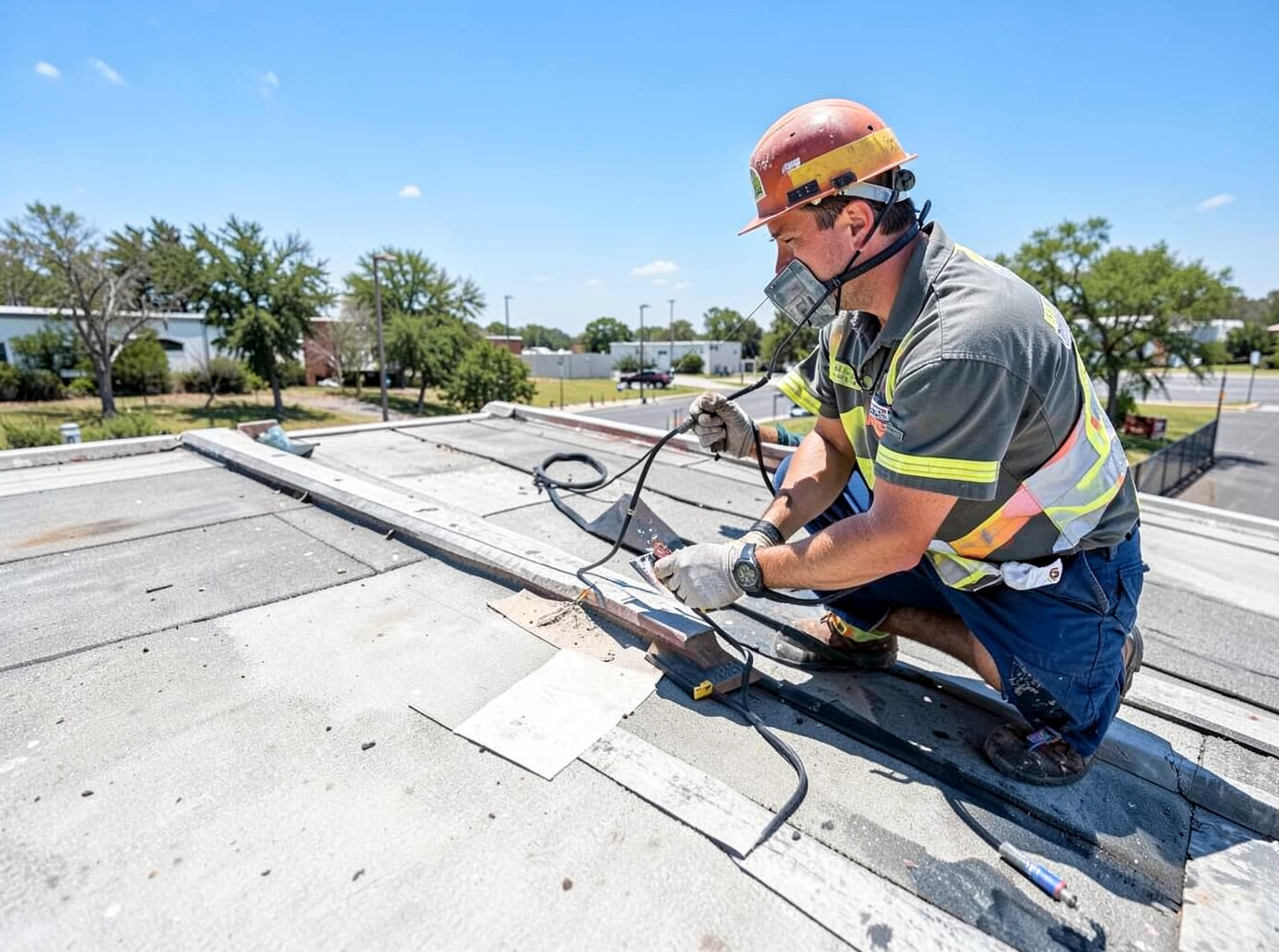
Most work in this area falls into a few repair categories. Leak tracing comes first: the provider follows the water path from the ceiling stain into the attic, checks the decking and rafters around the suspected entry, and then looks at the roof surface above. Targeted repairs often include replacing a pipe boot, resealing or replacing step flashing, repairing a valley, lifting and replacing damaged shingles, and correcting a gutter or downspout that is feeding water back under the roof edge. Each repair addresses a specific failed detail rather than the whole roof.
When the damage is larger, the conversation shifts. Local providers may recommend replacing a section of decking, re-flashing a whole wall intersection, or installing new underlayment in a valley that has been leaking for some time. Where water is actively coming through the ceiling during a storm, a temporary dry-in over the opening can limit further damage until a permanent repair is scheduled in daylight. Written notes, dated photographs and a clear description of each repair help homeowners compare options and keep records for their own files.
How does the permit process apply to a La Cima re-roof?
San Marcos adopted its current building codes through Ordinance 2023-09, with the codes in effect from 1 April 2023. These include the 2021 International Residential One and Two Family Code and the 2020 National Electric Code, as listed on the city's codes page. Applications for permits here are handled through the city's Building Permit process, which operates under the adopted Building Code. Homeowners should contact Planning and Development Services to confirm what applies to their specific job before work begins.
The re-roof rule in the adopted amendment is commonly described as a weight test. Local secondary sources written scope the amendment as stating that roof covering replacement permits are not required unless the weight of the replacement roof is heavier than the existing roof covering. Under that reading, a like-for-like shingle replacement is exempt, while a heavier covering such as concrete or clay tile or slate would be permitted work. Because another source states a different blanket rule, the weight test should be confirmed against the ordinance text with the city before any material is ordered. Homeowners should also know that the city has not been confirmed in the sources recorded to require a roofing contractor registration, so that claim should be verified directly. The seven local historic districts named by the city are Hopkins Street, Burleson Street, Lindsey-Rogers, Dunbar, Downtown, San Antonio Street and Belvin Street, and La Cima is not among them, though the parcel status should still be confirmed with the city.
What should La Cima homeowners inspect after a storm?
Begin from the ground and do not climb onto the roof during or right after a storm. Photograph the house from several angles, including the roof slopes, gutters, downspouts, fences, outdoor equipment and vehicles, and note the date of the storm. Dated photographs make it easier for a provider to match damage to a specific weather event if an insurance claim is later considered. Check the ceilings and walls inside for new stains, bubbling paint or drips, and check the attic with a flashlight for wet insulation, dark decking or daylight at penetrations.
Once conditions are safe, a closer look can focus on the common failure points. Check pipe boots for cracks, flashing for lifted edges, valleys for granules or debris build-up, and shingles for bruising, cracking or missing tabs. Look at metal vents, drip edge and gutters for dents, since soft metals often show hail impacts more clearly than shingles do. Cosmetic marks that do not affect water shedding are different from functional damage, and a local provider can help separate the two before any repair is planned.
How does a La Cima roof repair usually move from first contact to completion?
The process usually starts with a description of the problem, the location of the stain and when it appeared. Homeowners who have photographs from the ceiling, attic and exterior are in a strong position to share useful detail at this stage. The provider then arranges an inspection, traces the likely entry point and explains which findings are functional and which are cosmetic. A written summary of the proposed repair, including the parts involved and any follow-up items, gives the homeowner something to record before work is scheduled.
After the repair, the homeowner should check the ceiling and attic again following the next rain, and note any changes. If the work involved a material change, the permit question described earlier should be confirmed with the city before the job proceeds. Keeping the photographs, the written summary and any permit correspondence together in one folder makes future maintenance easier and helps the next provider understand the roof's history.
Still have questions? We're happy to talk it through.